Is Royal Reels Legit in Australia? Licence, ACMA Status and Trust Signals
 Available in US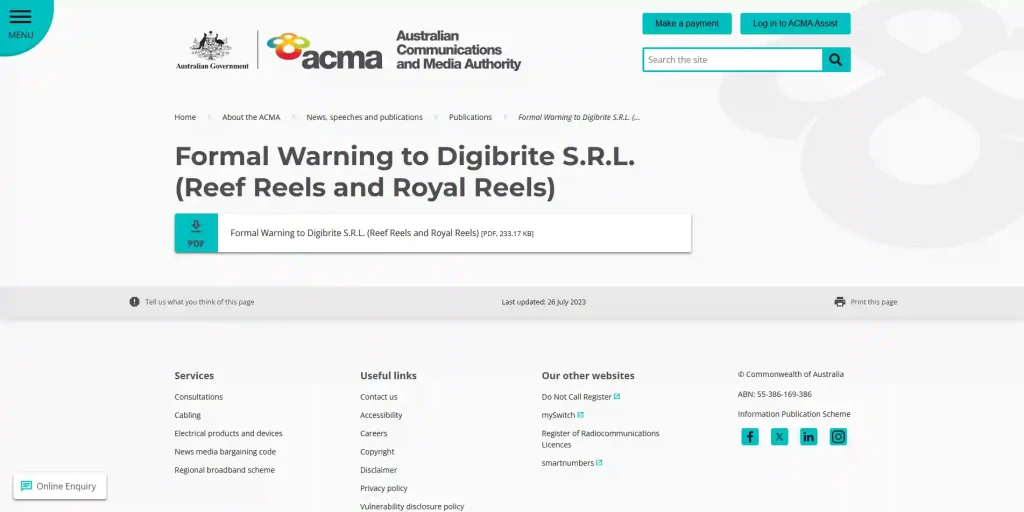
Royal Reels should not be described as Australian-licensed. The current ACMA register of licensed interactive gambling providers does not contain Royal Reels or Digibrite S.R.L., while Royal Reels is associated with Curaçao licensing. Separately, ACMA issued Digibrite S.R.L. a formal warning in 2023 concerning Royal Reels and Reef Reels. Those are distinct facts: an offshore licence does not become an Australian licence, and a working Australian-facing website does not create Australian regulatory approval.
ACMA also states that the Interactive Gambling Act 2001 makes it illegal for providers to offer certain online gambling services to people in Australia, including online casinos. A simplistic “legit” or “scam” label would obscure the useful questions: what each regulatory fact proves, what protection an Australian user does or does not receive, and which product or reputation signals need to be assessed separately.
Table of Contents
- The short regulatory answer
- What the ACMA register actually tells you
- ACMA’s 2023 formal warning to Digibrite
- How Australian online casino rules fit the picture
- Curaçao licensing is relevant, but it is not Australian protection
- What the lack of Australian registration means for trust
- The 2026 gambling reforms: what is already law and what starts later
- Trust signals that should be separated from regulation
- A simple evidence hierarchy for Royal Reels
- What “legit” should mean in this context
- How the evidence fits together for Australian readers
- Is Royal Reels Legit in Australia? Licence, ACMA Status and Trust Signals
The short regulatory answer
Royal Reels operates an Australia-facing online casino product, but no Australian interactive wagering licence was verified for Royal Reels or Digibrite S.R.L. in ACMA’s current public register. ACMA tells users that a legal online wagering service must appear on that register to operate in Australia. The register is focused on licensed interactive wagering providers, not on granting approval to offshore online casinos.
Royal Reels is instead associated with Curaçao as its licensing jurisdiction. That offshore licensing fact can be stated without implying Australian approval. The exact Curaçao licence number is omitted because a reliable current number could not be confirmed from the relevant register or operator licence page.
The result is a split regulatory picture: operational access and offshore licensing can exist at the same time as an absence from Australia’s licensed interactive wagering register and a documented ACMA enforcement history. Treating any one of those facts as if it cancels the others would make the analysis less accurate.
What the ACMA register actually tells you
ACMA’s current guidance says that before using an online wagering service, users should check whether it is on the register of licensed interactive gambling providers. The register lists the trading name, licence holder, URL and Australian licensing authority for approved wagering services. A search of that public register found no entry for “Royal Reels” and no entry for “Digibrite”.
That means Royal Reels does not have a verified Australian interactive wagering licence. It does not mean the site has no licence anywhere in the world, because the Curaçao jurisdiction is a separate licensing fact. It also does not prove that the operator refuses Australians: the current Royal Reels site explicitly presents itself to Australian users.
This separation is the most important regulatory literacy point on the page. Local licence status is not a proxy for every other fact. It should not be used to cast doubt on independently verified payment methods, games, bonuses, mobile access or support channels. Equally, those product features should not be used to imply that local licensing exists.
ACMA’s 2023 formal warning to Digibrite
Royal Reels has more than an absence-from-register issue. ACMA published a formal warning to Digibrite S.R.L. concerning Royal Reels and Reef Reels in July 2023. That is primary-source Australian enforcement evidence tied directly to the operator and brand. It should carry more weight than generic review-site claims that simply label a casino safe or unsafe.
A formal warning is not the same thing as an Australian licence cancellation, because there was no verified Australian Royal Reels licence in the first place. Nor is it a customer complaint ruling or a finding about every transaction made through the site. Its significance is regulatory: ACMA took enforcement action under the Interactive Gambling Act framework concerning the provision of the service.
For an Australian reader, that history changes the trust assessment. A brand can have a functional website, a broad game lobby and working payment options while still having a documented adverse interaction with the Australian regulator. Product usability and regulatory standing therefore need separate evidence.
How Australian online casino rules fit the picture
ACMA’s current explanation of the Interactive Gambling Act says that the law makes it illegal for gambling providers to offer some online services to people in Australia. Its list of banned services includes online casinos, in-play sports betting, sports betting services without an Australian licence and betting on the outcome of a lottery. The provider-side online casino rule is the most relevant part for Royal Reels.
This distinction matters because public discussion often jumps from “the provider is prohibited from offering the service” to a much broader statement about individual users. This is not personal legal advice, and no unsupported claim about player criminal liability is implied. The regulatory fact that can be supported is the provider-side prohibition ACMA describes.
Australian gambling regulation is also split across levels of government. State and territory authorities license and regulate many gambling activities, while Commonwealth law and ACMA address key online-gambling matters. That structure is why seeing a foreign licence badge does not answer the Australian regulatory question.
Curaçao licensing is relevant, but it is not Australian protection
Available operator and corroborating sources identify Curaçao as the Royal Reels licence jurisdiction. That tells a reader that the operator is not being presented as entirely unlicensed. It does not create an Australian licence, put Royal Reels on the ACMA register or automatically give users access to Australian licensed-wagering dispute channels.
Jurisdiction should therefore be read literally. “Licensed in Curaçao” is a statement about the licensing system under which the operator says it runs. “Licensed in Australia” would require a current Australian register hit, and none was found. The two formulations are not interchangeable.
The exact licence number is deliberately omitted. Licence numbers and expiry details are high-risk facts because they can be copied incorrectly, changed or attached to the wrong company. Without a fresh primary register confirmation, stating a number would add apparent precision without reliable support.
What the lack of Australian registration means for trust
The absence of Royal Reels from ACMA’s licensed-provider register has a practical consumer-protection implication: Australian users should not assume that the service sits inside the same local licensing and regulatory framework as an operator listed by ACMA. That matters when thinking about complaint routes, responsible-gambling systems tied specifically to Australian-licensed wagering services and regulator oversight.
ACMA’s page on the licensed-provider register tells users to avoid services not on the register. It also says that complaints about licensed providers can be directed to their licensing authority. For an offshore casino not present on the Australian register, those local assumptions should not be imported automatically.
This is different from saying that no dispute process exists at all. Royal Reels may provide its own internal support or offshore dispute mechanisms. The point is that they should not be described as Australian regulatory protection unless a local licence supports that claim.
The 2026 gambling reforms: what is already law and what starts later
Australia enacted the Interactive Gambling Amendment (Gambling Reform) Act 2026 on 26 August 2026. The Act is in force as legislation, but its commencement table is important: sections 1 to 4 commenced on Royal Assent, Schedule 5 commenced on 27 August 2026, and all other Schedules are set to commence on 1 January 2027. That means many headline reforms should not be written as though their substantive operating rules are already fully in effect in September 2026.
The reform package covers restrictions on wagering advertising, a wagering advertising opt-out register, inducement controls, restrictions on commissions linked to customer activity, stronger mechanisms for disrupting illegal gambling services, BetStop changes and online lottery measures. ACMA’s current summary likewise says that most reforms commence on 1 January 2027.
For Royal Reels, the most relevant theme is the stronger illegal-service disruption framework rather than the parts designed around licensed wagering advertising. The reform context shows the direction of Australian enforcement, but it does not erase the need to analyse the specific current facts: Royal Reels’ register status, offshore licensing and existing ACMA warning remain the concrete evidence today.
Trust signals that should be separated from regulation
A useful trust review should not stop at the word “licence”. Payment transparency, withdrawal handling, account verification, support availability, domain continuity and player complaint patterns all matter, but they answer different questions. A regulator register can show whether local licensing exists; it cannot tell you whether a particular support interaction was good. A player review can describe an experience; it cannot confer a licence.
Royal Reels currently publishes card and cryptocurrency payment options and an Australia-facing product. Those operational features are covered on the royal reels payment methods page. Withdrawal expectations and KYC implications are covered separately on the Royal Reels Withdrawals page and the Royal Reels Registration and KYC.
Reputation evidence also deserves its own treatment. Complaints can be valuable when patterns repeat across independent sources, but isolated anecdotes should not be converted into factual claims about all users. The child page on Royal Reels Player Reviews and Complaints handles that evidence rather than mixing it into the regulatory analysis.
A simple evidence hierarchy for Royal Reels
| Question | Best evidence | What it can establish |
|---|---|---|
| Is Royal Reels Australian-licensed? | ACMA licensed-provider register | No verified Royal Reels or Digibrite entry was found. |
| Has ACMA acted against the operator? | ACMA formal warning | Digibrite received a formal warning concerning Royal Reels and Reef Reels in 2023. |
| What does Australian federal law say about online casinos? | Interactive Gambling Act and ACMA guidance | Providers must not offer prohibited online casino services to people in Australia. |
| What foreign licence jurisdiction is associated with Royal Reels? | Current operator and corroborating licence sources | Curaçao jurisdiction, without publishing an unverified licence number. |
| Does the site currently serve Australians? | Current Australia-facing Royal Reels site | Operational AU-facing access, which is separate from local licensing. |
What “legit” should mean in this context
If “legit” is being used to mean “holds an Australian interactive wagering licence”, the answer is no verified licence was found. If it means “is there a real Royal Reels service with an identifiable operator and foreign licensing jurisdiction”, the evidence supports the existence of the service, its association with Digibrite S.R.L. and Curaçao licensing. If it means “has the Australian regulator raised no concern”, that would also be inaccurate because ACMA issued a formal warning concerning Royal Reels.
Those answers can coexist because the word “legit” compresses several different tests into one label. A more useful decision process asks separate questions: Is the operator identifiable? Is there a licensing jurisdiction? Is there an Australian licence? Has ACMA taken action? Are payment and withdrawal claims supported? Are complaint patterns material? Only after those questions are separated can a reader decide how much regulatory and operational risk is acceptable.
How the evidence fits together for Australian readers
Royal Reels is an operating Australia-facing casino service associated with Digibrite S.R.L. and the Curaçao licensing jurisdiction, but it does not have a verified Australian interactive wagering licence. ACMA’s public register contains no Royal Reels or Digibrite entry, and ACMA published a formal warning to Digibrite in 2023 concerning Royal Reels and Reef Reels. Australian federal guidance also identifies online casino services as prohibited services for providers to offer to people in Australia.
That combination argues for precision rather than a single label. Offshore licensing should be acknowledged, but it should not be presented as Australian approval. Product facts can be evaluated independently, but a working product should not be used as evidence of local regulatory protection. The 2026 reforms add a stronger future enforcement and advertising framework, with most substantive schedules commencing on 1 January 2027 rather than already operating in full.
For a broader product view, use the Royal Reels Australia review. For reputation evidence beyond licences and regulators, continue to the player reviews and complaints analysis.